Brick Beats
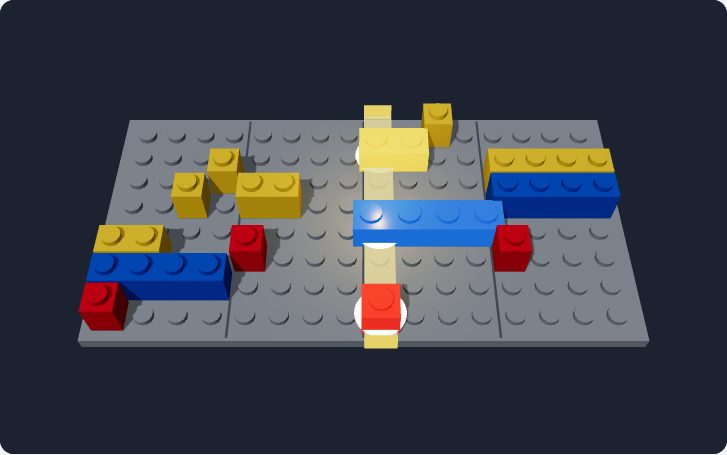
The plate is the song. Left to right is time, low to high is pitch, and the colour picks the instrument.
 Play it (sound on)
The question
Does making music with bricks feel like play, and does every plate become a different song?
Here the song is something you build, and you can see all of it at once. I want to know whether children treat it like building (trying, changing, making a pattern) or like a noise box.
The idea on a real plate
Like Living Plate, the real version is bricks on a real plate with a phone looking at it. The plate plays, and you change the song by moving bricks with your fingers. It needs the same plate reader, so the two ideas share their hardest part.
What you do
A light bar sweeps over a 16 by 8 plate, one bar of music every pass. You pick an instrument and a brick length and tap the plate. The brick plays at once, then again every time the bar reaches it. You keep building while it plays. There are three ready-made songs, a speed slider, and a Surprise me button that fills the plate with a random song that still sounds musical.
| Colour | The instrument: red drums, blue bass, yellow melody, green chime. |
|---|---|
| Length | How long the note lasts: one, two or four studs. |
| Height | Stack the same brick again and it plays louder, up to three high. |
| Row | The pitch. For drums, the row picks the drum: kick at the bottom, hi-hat and shaker at the top. |
Choices I made
- Every note comes from one five-note scale, so the notes never clash, whatever a child builds.
- One brick per stud, like a real plate. If a row is taken, the brick doesn't go in and the page says why.
- The sound is made in the browser as it plays, with no recorded samples, and the notes are timed on the audio clock so the beat stays steady even when the screen stutters.
- When a brick plays it jumps, lights up and sends a ring across the plate, so you can see which brick made which sound.
What I checked
- Tests cover the rules: a brick plays when the bar reaches its left end and lasts as long as it is long, bricks can't overlap, stacking gets louder, and every pitch on the plate is in the scale.
- The three ready-made songs fit on the plate completely and are all different.
- I played it with clicks on a laptop and with taps on a phone screen, with a meter on the audio output. Sound comes out while it plays and stops when it stops, bricks added during play join the song, and a tap on a taken stud is refused.
What I don't know yet
- How it sounds to a person. I have measured that sound comes out, not whether it is pleasant. Nobody has listened to it critically yet.
- Whether 16 by 8 is the right size, and whether four instruments are too many or too few.
- Whether children make patterns or just fill the plate, and whether two children can make a song together on one plate.
How I'd test it
- Who
- Three adults first, for a plain listening check. Then six children aged 6 to 10 in pairs, fifteen minutes each, with headphones or a speaker.
- Setup
- Start on A little tune, playing. After three minutes, clear the plate.
- What I watch
- Do they change the song while it plays? Do they repeat a pattern on purpose, or fill every stud? Do they ask to hear each other's song? Does a pair share the plate or split it?
- What counts as a yes
- Most children build a pattern they then change on purpose, and want to play it to someone.
- What it decides
- If it reads as building, it earns the plate reader alongside Living Plate. If it reads as noise, the next version gets fewer instruments and a smaller plate before anything else.
Next steps
- The adult listening check, and fixes to any sound that grates.
- Run the sessions above.
- The shared camera test described in the Living Plate notes.
Where it could go
It can grow into a proper music-making tool, closer to a digital audio workstation, with songs published and shared on the platform.
Every plate is also a ready-made sample, and you hold the physical version of your track in your hands: bring the plate to a friend and the song comes with it.
What already exists
I looked after building it, and plainly, the core idea already exists:
- BeatBlocks (Playable Technology, 2023): an iPhone and iPad app whose camera reads real bricks on a baseplate and plays them as an 8-beat loop, colour picking the instrument, with MIDI out in the paid version. It also runs as a large installation at LEGOLAND Discovery Centres and museums.
- BrickMusicTable (University of Vienna, 2024) and Beat Bricks (2012): research and hobby versions of a camera reading a brick plate as a sequencer.
- Osmo Coding Jam: a tablet camera reads physical blocks arranged into music.
- Chrome Music Lab Song Maker: the free on-screen grid version.
The differences are in the details: brick length as note length, stacking as volume, a fixed five-note scale, and 16 steps instead of 8. And in where it could go, a fuller music tool and a place to publish songs. If I took it further, the first step would be to play BeatBlocks with children and see what it leaves out, or to stop here.
A personal project, not made, endorsed or affiliated with the LEGO Group. LEGO is a trademark of the LEGO Group. Products named above belong to their owners; every link was checked on 6 November 2026.